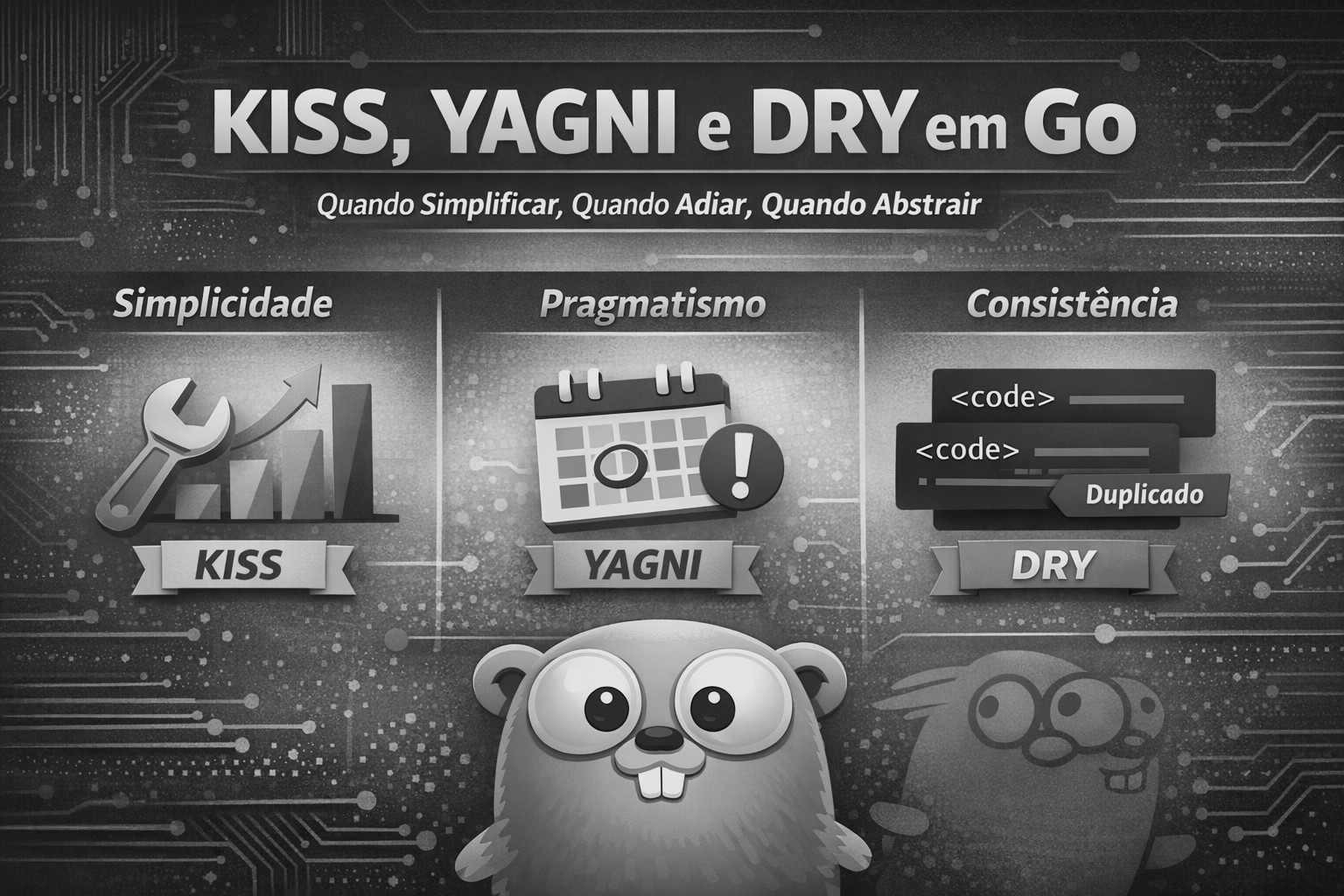
KISS, YAGNI, and DRY in Go
Just as SOLID organizes principles aimed at object-oriented design, KISS, YAGNI, and DRY help guide day-to-day architectural decisions.
They do not define structure by themselves. They help guide mindset and decision-making.
In this post, I share what I have been learning about design and architecture best practices, especially in Go.
In Go — a language designed for simplicity, clarity, and composition — these principles become more evident in practice.
Here, the goal is to explore together:
- The conceptual origin of these principles
- A quick decision map for daily work
- Practical examples in Go
- Maturity and warning signs
- Real trade-offs
Quick Decision Map
Before the examples, here is a summary you can use day to day:
| Principle | Key question | Practical goal | Common anti-pattern |
|---|---|---|---|
| KISS | Is there a simpler way to solve this? | Reduce accidental complexity | “Pass-through” layers |
| YAGNI | Does this solve a real problem today? | Avoid premature investment | Hypothetical extensibility |
| DRY | Is the same domain rule repeated? | Preserve consistency | Generic abstraction too early |
Remember these principles are not rigid rules, but guides for reflection. Context always matters.
KISS simplifies structure. YAGNI protects time. DRY protects knowledge.
Historical Context
KISS — “Keep It Simple, Stupid”
The KISS principle emerged in military engineering in the 1960s, associated with U.S. Navy system design (source).
The core idea was simple:
Simple systems fail less.
In software engineering, this means reducing unnecessary complexity.
YAGNI — “You Aren’t Gonna Need It”
YAGNI gained traction within the Extreme Programming (XP) movement in the 1990s (source).
The proposal was straightforward:
Do not implement today what is not yet a real requirement.
Excessive anticipation creates waste.
DRY — “Don’t Repeat Yourself”
DRY was formalized in The Pragmatic Programmer (source).
Its more precise definition is:
Every piece of knowledge must have a single, unambiguous representation within a system.
It is not about repeating code. It is about repeating business rules.
The Problem: Accidental Complexity
Architecture is about trade-offs — and this becomes clearer with practice.
When we overdo abstraction, we usually pay with:
- too many types
- unnecessary indirection
- harder debugging
- slower onboarding
Go was designed to reduce structural friction. When we ignore this, we end up creating accidental complexity.
KISS — Keep It Simple, Stupid
If two solutions solve the same problem, the simpler one is usually the better choice.
Example with unnecessary complexity
// Generic repository, designed for multiple data sources
type UserRepository interface {
    FindByID(id string) (User, error)
}

// Current implementation, with no real variations
type UserService interface {
    GetUser(id string) (User, error)
}

// Concrete implementation that only forwards the call
type userService struct {
    repository UserRepository
}

// Today there is only one real implementation, but we already created interface and struct
func NewUserService(repository UserRepository) UserService {
    return &userService{repository: repository}
}

// Method that only forwards the call, with no additional logic
func (service *userService) GetUser(id string) (User, error) {
    return service.repository.FindByID(id)
}
This is a pass-through architecture: multiple types just forwarding calls.
Simpler version
// Direct implementation, without unnecessary abstraction
type UserRepository struct{}

// Today there is only one real implementation, without a generic interface
func (repository *UserRepository) FindByID(id string) (User, error) {
    // ...query...
    return User{}, nil
}

// Direct service, without generic interface
type UserService struct {
    repository *UserRepository
}

// Direct constructor, without forwarding indirection
func NewUserService(repository *UserRepository) *UserService {
    return &UserService{repository: repository}
}

// Direct method, no extra logic
func (service *UserService) GetUser(id string) (User, error) {
    return service.repository.FindByID(id)
}
Less indirection, same functionality.
When should you use an interface?
- Multiple real implementations today
- External boundary (infrastructure, SDK, integration)
- Explicit isolation for tests
Warning signs (KISS)
- You navigate through 3 or more types to find a trivial rule
- A simple change requires touching too many files
Maturity signs (KISS)
- The main flow can be explained in a few steps
- Reading reveals intent before technical details
Trade-off (KISS)
KISS helps when it reduces accidental coupling, but hurts when it becomes naive simplification and ignores real requirements (observability, security, infrastructure isolation).
YAGNI — You Aren’t Gonna Need It
A recurring lesson: do not build solutions for problems that do not exist yet.
Example of premature abstraction
// Pricing strategy, anticipating future variations
type PriceStrategy interface {
    Calculate(base float64) float64
}

// Current implementation, with no real variations
type DefaultPriceStrategy struct{}

// Today there is only one pricing behavior, but we already created interface and struct
func (DefaultPriceStrategy) Calculate(base float64) float64 {
    return base
}

// Imagining a future variation, but with no concrete scenario
type BlackFridayStrategy struct{}

// Hypothetical implementation, with no evidence of real need
func (BlackFridayStrategy) Calculate(base float64) float64 {
    return base * 0.7
}
If today there is only one real behavior, this structure may be premature.
More pragmatic version
// Direct implementation, without anticipatory abstraction
func CalculatePrice(base float64) float64 {
    return base
}
When a second real and stable variation appears, then extracting a strategy can make sense.
Warning signs (YAGNI)
- “Let’s prepare for the future” without a concrete scenario
- Many hypothetical extension points, but no real usage
Maturity signs (YAGNI)
- Code evolves in small iterations
- Extensions emerge from observed requirements
Trade-off (YAGNI)
YAGNI avoids waste. Misapplied, it can become myopia: ignoring requirements already signaled by business or external contracts.
DRY — Don’t Repeat Yourself
DRY is not “never repeat lines”; it is avoiding duplication of the same domain rule in different places.
Example with duplicated rule
// Password validation rule, repeated in two places
func CreateUser(input CreateUserInput) error {
    if len(input.Password) < 8 {
        return errors.New("password must be at least 8 characters")
    }
    // ...creation...
    return nil
}

// Same rule repeated in another context
func ResetPassword(input ResetPasswordInput) error {
    if len(input.Password) < 8 {
        return errors.New("password must be at least 8 characters")
    }
    // ...reset...
    return nil
}
The domain rule is duplicated.
Version with centralized rule
// Centralized function to validate password
func ValidatePassword(password string) error {
    if len(password) < 8 {
        return errors.New("password must be at least 8 characters")
    }
    return nil
}

// Password validation using centralized function
func CreateUser(input CreateUserInput) error {
    if err := ValidatePassword(input.Password); err != nil {
        return err
    }
    // ...creation...
    return nil
}

// Same rule reused without duplication
func ResetPassword(input ResetPasswordInput) error {
    if err := ValidatePassword(input.Password); err != nil {
        return err
    }
    // ...reset...
    return nil
}
Now the rule has a single maintenance point.
Warning signs (DRY)
- Same rule copied across handlers, services, and jobs
- A bug fixed in one place but forgotten in another
Maturity signs (DRY)
- Core rules live in cohesive functions/modules
- Names reflect domain intent, not technical detail
Trade-off (DRY)
DRY preserves consistency; applied too early, it can create poor generic abstractions and increase coupling between contexts that should stay separate.
How to balance KISS, YAGNI, and DRY in daily work
How can we apply these principles in practice without falling into dogma or implementation traps?
- Start simple (KISS)
- Implement only what is needed now (YAGNI)
- When a rule truly repeats, consolidate it (DRY)
When in doubt, ask:
- Does this abstraction remove real complexity or just move complexity around? (source)
- Is there evidence of variation now, or is it just a hypothesis? (source)
- Am I centralizing knowledge or coupling different concerns? (source)
Conclusion
KISS, YAGNI, and DRY do not compete with each other. They complement each other.
Over time, the pattern becomes clearer:
- KISS reduces accidental complexity
- YAGNI avoids premature investment
- DRY protects domain consistency
In Go, these principles stand out because the language favors clarity and composition. And in practice, learning is continuous: less about following dogma, more about making good trade-off decisions in the right context.